
Why That Rs. 500 Tee is Costing You More Than You Think – The T-Shirt Hierarchy

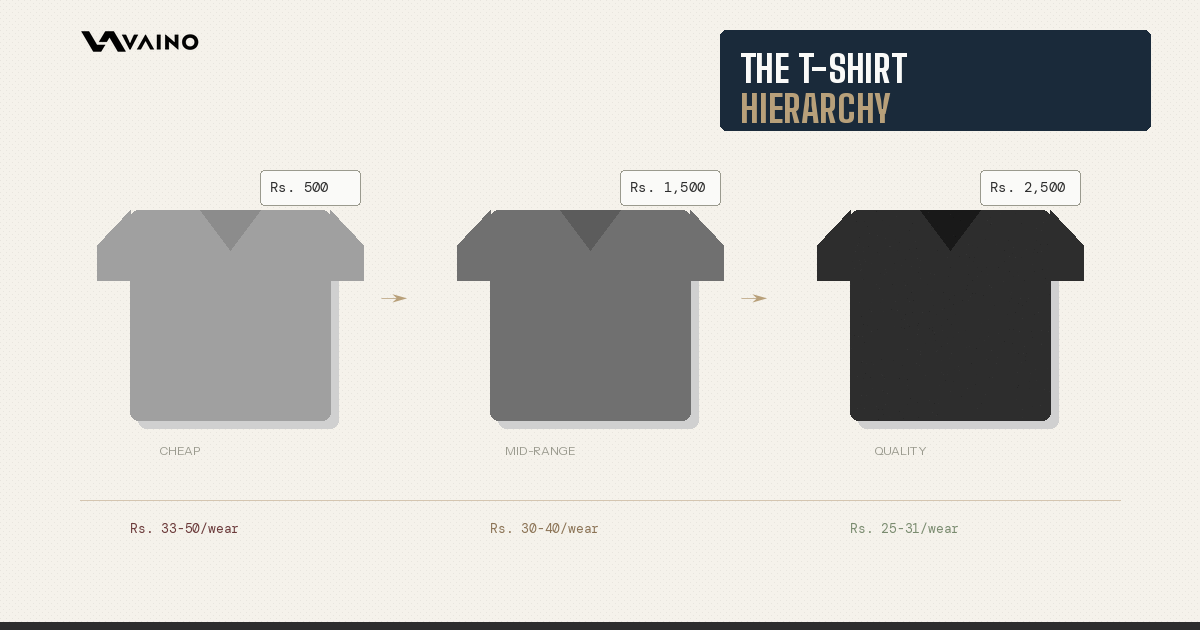
You’re standing in a market stall or scrolling through an online store. There’s a t-shirt for Rs. 500. Next to it, there’s one for Rs. 2,500. They’re both cotton. They’re both black. They both have crew necks. So why would anyone pay five times more for what looks like the same thing?
This is the question that separates men who wear clothes from men who understand clothes. And the answer reveals why that cheap t-shirt is actually the expensive choice.
The humble t-shirt is the most underestimated garment in menswear. It’s the foundation of casual style, the base layer of countless outfits, and often the first thing people notice when you remove your jacket. Yet most Pakistani men treat t-shirt purchases as afterthoughts — bulk buys from wherever’s cheapest.
This guide will teach you to see t-shirts differently. You’ll learn exactly what separates quality from cheap, how to calculate the true cost of what you buy, and why investing in better basics transforms your entire wardrobe.
The True Cost of Cheap: What Rs. 500 Actually Buys You
Let’s be brutally honest about what happens when you buy the cheapest t-shirt available. Not to shame anyone — we’ve all done it — but to understand the real economics at play.
The Fabric Reality
A Rs. 500 t-shirt uses the cheapest cotton available — short-staple fibres that feel rough, pill quickly, and break down after minimal washing. The fabric is thin (often under 140 GSM), which means it drapes poorly, shows every imperfection, and becomes see-through in certain lights.
Worse, cheap fabric shrinks unpredictably. That t-shirt that fit perfectly in the store? After three washes, it’s either a crop top or stretched beyond recognition. You’ve saved money on the purchase and lost it on the replacement.
The Construction Shortcuts
Manufacturing a t-shirt cheaply requires cutting corners — literally. Budget t-shirts use single-needle stitching that unravels quickly, hems that curl after washing, and necklines that stretch out of shape. The seams are often uneven, creating an asymmetrical fit that makes even a well-built man look sloppy.
Pay attention to the collar especially. On cheap t-shirts, the collar begins to warp and ripple within weeks. That wavy, stretched-out neckline is the universal signal of a low-quality garment — and everyone notices it, even if they can’t articulate why you look ‘off.’
The Lifespan Problem
Here’s where the math gets interesting. A Rs. 500 t-shirt typically lasts 10-15 wears before it starts looking worn. Fading, pilling, shape loss — the deterioration is rapid. If you wear it once a week, you’re replacing it within three to four months.
A quality t-shirt at Rs. 2,500, properly cared for, lasts 80-100 wears while maintaining its appearance. Same once-a-week schedule? That’s nearly two years of service.
| Factor | Rs. 500 T-Shirt | Rs. 2,500 T-Shirt |
| Usable Wears | 10-15 wears | 80-100 wears |
| Cost Per Wear | Rs. 33-50 | Rs. 25-31 |
| 2-Year Cost (weekly wear) | Rs. 3,000-4,000 (6-8 replacements) | Rs. 2,500 (1 shirt) |
| Appearance Quality | Degrades from day one | Maintains quality throughout |
The ‘cheap’ t-shirt costs Rs. 500-1,500 more over two years than the quality option — and you look worse the entire time. This is the cost-per-wear principle that smart dressers understand instinctively.
The Three Markers of Quality: What to Look For
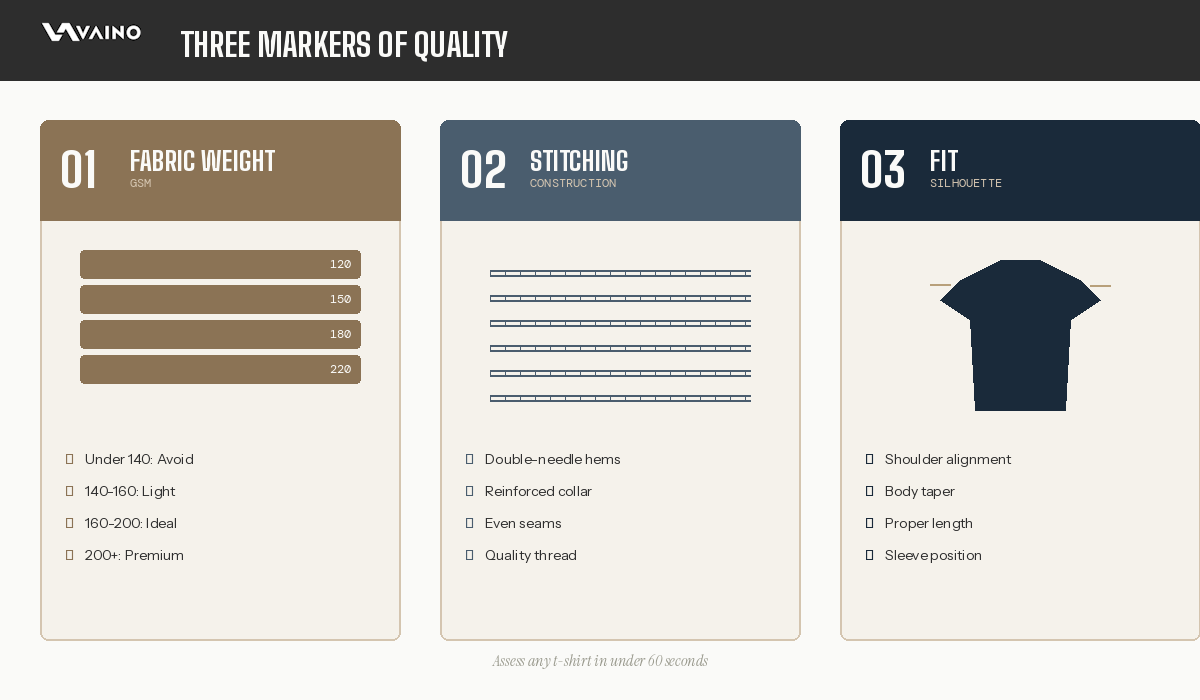
You don’t need a textile degree to identify a quality t-shirt. Three factors tell you almost everything you need to know — and you can assess all three in under sixty seconds.
Marker 1: Fabric Weight (GSM)
GSM stands for ‘grams per square metre’ — it’s how fabric weight is measured. This single number tells you more about a t-shirt’s quality than almost any other specification.
- Under 140 GSM: Avoid. This is tissue-paper territory. The fabric will be see-through, won’t drape properly, and will deteriorate rapidly.
- 140-160 GSM: Lightweight, suitable for hot Pakistani summers, but requires quality construction to hold up. Good for undershirts or very casual wear.
- 160-200 GSM: The sweet spot. Substantial enough to drape well and hide imperfections, light enough for year-round comfort. This is where quality everyday t-shirts live.
- 200+ GSM: Premium heavyweight. Exceptional structure and durability, but can be warm. Best for layering or cooler weather.
The Touch Test: Hold the fabric up to light. Can you see your hand through it? That’s too thin. Now pinch it between your fingers. Does it feel substantial, or does it feel like you could tear it? Quality fabric has body — it feels like something.
Marker 2: Stitching Quality
Turn the t-shirt inside out. What you see here reveals the manufacturer’s priorities.
Check the seams: Quality t-shirts use double-needle stitching on the hems and side seams. This creates two parallel lines of stitching that reinforce each other. Single-needle stitching (one line) unravels faster and creates a less durable garment.
Examine the collar: The collar should be reinforced, either with ribbed knit binding or taped seams. Pull gently on the neckline — it should spring back to shape, not stretch and stay stretched. A collar that deforms under light pressure will be a shapeless mess within weeks.
Look at the hem: The bottom hem should be wide enough (at least 2cm) and stitched consistently. Narrow hems curl upward after washing. If the stitching is uneven or the thread is a different colour than intended, quality control is lacking.
Marker 3: Fit Construction
Two t-shirts can be labelled ‘Medium’ and fit completely differently. Quality manufacturers invest in fit development — creating patterns that flatter the human body rather than just covering it.
Shoulder seams: Should sit exactly at the edge of your shoulder — not drooping down your arm (too big) or pulling toward your neck (too small). This single measurement determines whether a t-shirt looks intentional or accidental.
Body taper: Quality t-shirts are slightly narrower at the waist than at the chest, following the natural shape of a male torso. Cheap t-shirts are often cut straight, creating a boxy, unflattering silhouette.
Length: The hem should fall at or just below your belt line — long enough to stay tucked if needed, short enough to look proportional untucked. T-shirts that are too long make you look shorter; too short and you’re constantly adjusting.
Sleeve length: Sleeves should end at mid-bicep for most men. Sleeves that are too short look juvenile; sleeves that extend past mid-bicep add visual weight to your arms and look sloppy.
The T-Shirt’s Secret Power: Foundation of Every Outfit
Here’s something most men don’t realise: a great t-shirt makes everything you wear with it look better. A mediocre t-shirt drags everything down.
The Multiplier Effect
Imagine you own a Rs. 15,000 jacket. It’s well-made, fits perfectly, and looks fantastic on the hanger. Now imagine wearing that jacket over a Rs. 500 t-shirt with a stretched collar and faded fabric. What does the combination look like?
The cheap t-shirt lowers the perceived quality of the jacket. Your eye is drawn to the gap between them. The outfit looks confused — like someone who spent money in the wrong places.
Now reverse it. A Rs. 2,500 quality t-shirt under a Rs. 5,000 jacket looks more cohesive and intentional than the first combination, despite costing less overall. The quality base layer elevates everything above it.
This is the multiplier effect: your outfit is only as good as its weakest visible element. And the t-shirt is almost always visible.
The Solo Test
There’s another consideration: at some point, you’ll take off your jacket. Maybe you’re in a heated room. Maybe you’re relaxing after a meeting. Maybe you’re driving home.
When that jacket comes off, your t-shirt is your entire outfit. Does it pass the solo test? Can your t-shirt stand alone as a complete, presentable look? Or does it suddenly reveal that your put-together appearance was a facade?
A quality t-shirt passes the solo test. It looks intentional whether it’s the base layer of a complex outfit or the only layer you’re wearing. That confidence — knowing you look good at every level of undress — is worth the investment.
Five Ways to Style the Same T-Shirt
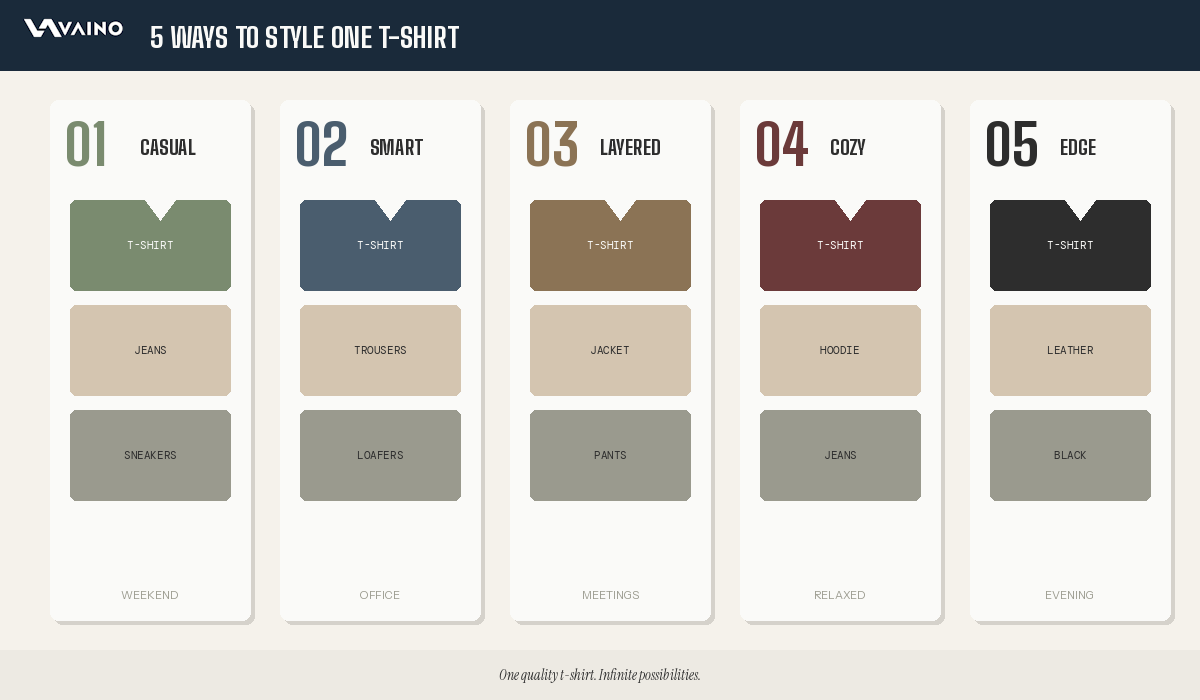
Let’s prove the versatility of a quality t-shirt. Take a well-fitted white or grey tee and see how it transforms across contexts:
1. Casual Everyday
Combination: Quality t-shirt + well-fitted jeans or chinos + clean sneakers
The Effect: This is the baseline — simple, clean, universally appropriate. The quality of your t-shirt determines whether this looks effortlessly stylish or carelessly underdressed. With a great tee, you look like you chose simplicity; with a cheap one, you look like you gave up.
2. Smart Casual
Combination: Quality t-shirt + tailored trousers + loafers or minimal leather sneakers
The Effect: The contrast between casual t-shirt and dressy trousers creates intentional tension. This only works if the t-shirt looks expensive — otherwise, it reads as ‘forgot to finish getting dressed.’ The fabric weight and fit become crucial here.
3. Layered Under a Jacket
Combination: Quality t-shirt + unstructured blazer or shirt jacket + dark pants
The Effect: This is the modern professional look — formal enough for most workplaces, relaxed enough to feel approachable. Your t-shirt is visible at the neckline and when the jacket opens. That visible strip needs to look deliberate, not default.
4. Under a Hoodie or Sweater
Combination: Quality t-shirt + hoodie or crewneck sweater + jeans + casual shoes
The Effect: The t-shirt acts as true base layer here, visible only at the neckline. Even this small exposure matters — a stretched-out collar peeking above your sweater undermines the entire look. A quality t-shirt maintains its structure even when mostly hidden.
5. Date Night Edge
Combination: Black quality t-shirt + black jeans + leather jacket + boots
The Effect: Monochromatic looks demand quality at every level — there’s nowhere for cheap fabric to hide. A well-constructed black t-shirt becomes the canvas that holds this outfit together. The fit, the fabric drape, the collar shape — everything shows in this context.
Building Your Quality T-Shirt Collection
You don’t need twenty t-shirts. You need the right t-shirts. Here’s how to build a collection that covers every need:
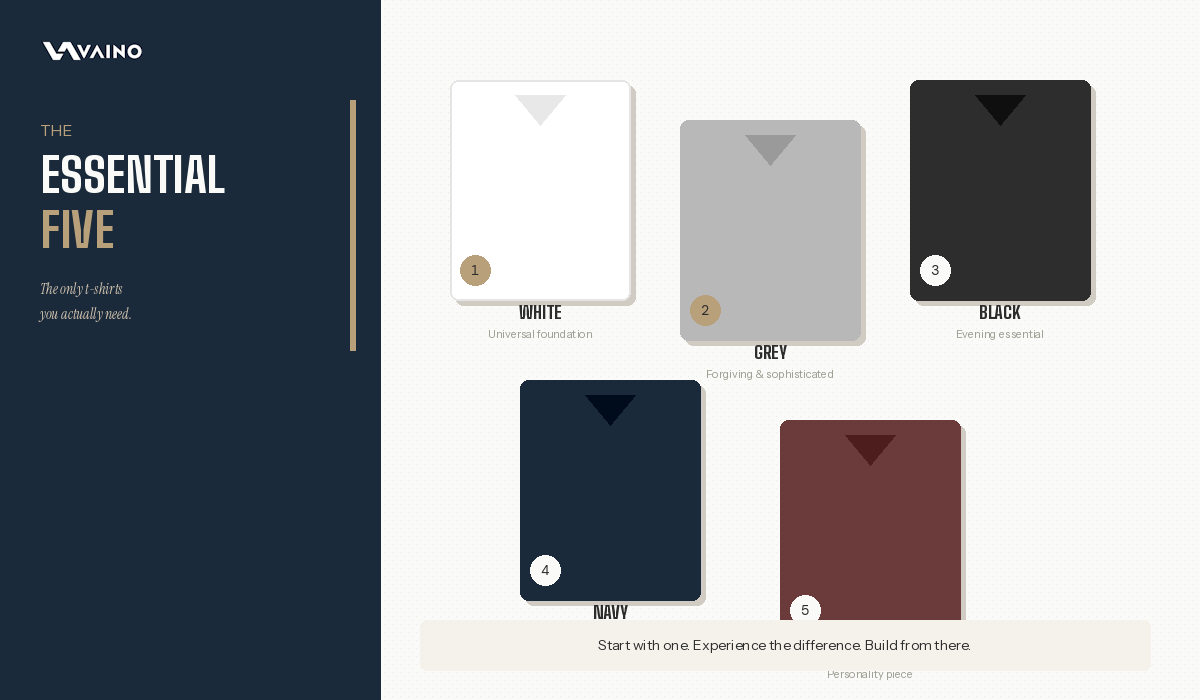
The Essential Five
- White Crew Neck: The single most versatile t-shirt in existence. Works with literally everything, in every context. This should be your first quality t-shirt purchase.
- Grey Crew Neck: Heather grey is forgiving, sophisticated, and pairs beautifully with both warm and cool colours. Your second essential.
- Black Crew Neck: Essential for evening wear and monochromatic outfits. Black shows quality differences more than any other colour — fabric weight and construction are immediately apparent.
- Navy Crew Neck: A sophisticated alternative to black that works better with most skin tones. Excellent for smart casual settings.
- Olive or Burgundy: Your personality piece. Either colour adds interest to neutral outfits without being loud. Choose based on whether warm (burgundy) or cool (olive) tones suit you better.
The Upgrade Path
Don’t try to upgrade your entire t-shirt drawer at once. Instead, follow this progression:
- Month 1: Replace your most-worn t-shirt (probably white or grey) with a quality version. Experience the difference daily.
- Month 2-3: Add black and navy. You now have a quality t-shirt for any basic outfit.
- Month 4-5: Add your personality colour. Begin retiring cheap t-shirts as they wear out — don’t replace them.
- Month 6+: Duplicate your most-worn colours. Two quality white t-shirts in rotation last longer than one, with less washing wear on each.
Care That Protects Your Investment
A quality t-shirt can last years — but only if you treat it properly. Most t-shirt damage comes from washing and drying, not wearing.
Washing Rules
- Cold water only: Hot water breaks down cotton fibres and causes shrinkage. Cold water cleans effectively while preserving fabric integrity.
- Turn inside out: This protects the outer surface from friction during the wash cycle, reducing pilling and fading.
- Gentle cycle: Aggressive cycles are unnecessary for t-shirts and accelerate wear. Gentle or delicate settings are sufficient.
- Avoid overloading: Packed washers create friction and stretching. Give your clothes room to move.
Drying Rules
- Air dry when possible: Tumble dryers are the number one destroyer of t-shirts. The heat and tumbling break down fibres and cause shrinkage.
- Lay flat or hang properly: Hanging wet t-shirts by the shoulders can stretch them. Either lay flat or hang by the hem.
- Keep out of direct sunlight: Sun exposure fades colours, especially blacks and navies. Dry in shade whenever possible.
The Bottom Line
The t-shirt is the most democratic garment in menswear — everyone owns them, everyone wears them. But there’s a hierarchy within this democracy, and where you place yourself matters more than most men realise.
That Rs. 500 t-shirt isn’t saving you money. It’s costing you in replacement frequency, in outfit quality, in the subtle but real impression you make on everyone who sees you. It’s costing you the confidence that comes from knowing you look good at every layer.
The quality t-shirt is an investment that pays dividends every single time you wear it. It makes your jackets look better, your jeans look more intentional, your entire presence more polished. And when you calculate the true cost per wear, it’s actually the affordable choice.
Start with one. Just one quality t-shirt in the colour you wear most. Experience the difference. Feel the fabric. Notice how it drapes. Watch how it holds up wash after wash while your cheap tees deteriorate around it. That single t-shirt will teach you everything this article has tried to explain — and it will change how you approach every clothing purchase from that point forward.
In the hierarchy of t-shirts, the question isn’t whether you can afford to buy quality. It’s whether you can afford not to.
| Experience the Difference Explore Vaino’s collection of premium t-shirts — quality fabrics, expert construction, and fits designed for the modern Pakistani man. Start building your quality foundation today. Shop Quality Vaino T-Shirts |